

For many companies, switching to solar power is no longer just a sustainability statement—it’s a financial strategy. Businesses want lower operating costs, protection from rising utility rates, and long-term energy security. While government incentives and tax credits certainly help, they only cover part of the story. What really drives successful projects are strong, creative Financing Strategies for Commercial Solar that make installations practical and profitable.
From power purchase agreements (PPA) to solar leasing options, and from structured tax equity partnerships to innovative solar finance models, businesses today have a wide range of tools to fund their projects. The right choice depends on cash flow priorities, risk appetite, and growth plans.
In this article, we’ll explore the most effective Financing Strategies for Commercial Solar, explain how they work, and show how companies in states like South Carolina, Georgia, and Virginia can maximise value.
Why Financing Strategies for Commercial Solar Matter
Incentives come and go, but strategic financing has lasting impact. The right structure provides:
-
Predictable costs – Stable energy prices for decades.
-
Capital efficiency – Avoiding large upfront expenditures.
-
Flexibility – Choosing ownership or service-based models.
-
Scalability – Ability to expand as energy demand grows.
Businesses that focus only on incentives risk short-term wins but miss long-term financial security. Strong Financing Strategies for Commercial Solar ensure projects remain viable even as policies evolve.
Power Purchase Agreements (PPA)
One of the most popular Financing Strategies for Commercial Solar is the power purchase agreement (PPA). Under this model, a third-party developer installs, owns, and operates the solar system on the business’s property. The business then agrees to purchase the electricity produced at a fixed rate, often lower than grid prices.
Benefits of PPAs
-
No upfront capital required.
-
Predictable energy bills with long-term contracts.
-
Maintenance and performance handled by the provider.
-
Immediate savings when contract rates beat utility prices.
PPAs are particularly attractive for businesses that want the benefits of solar without owning or managing the equipment.
Solar Leasing Options
Leasing provides another accessible entry point. With solar leasing options, the business pays a fixed monthly fee to use the system while ownership remains with the provider.
Advantages of Leasing
-
Lower initial cost compared to outright purchase.
-
Fixed payments make budgeting simple.
-
Upgrade flexibility at the end of the lease term.
-
Access to solar technology without long-term asset risk.
While leasing may lead to higher overall costs compared to direct ownership, it remains a powerful commercial solar financing tool for companies that value cash flow preservation.
Tax Equity Partnerships
For larger businesses, structured tax equity partnerships can unlock additional value. In this setup, outside investors with tax liabilities provide funding for the system in exchange for credits and depreciation benefits. The business hosting the project gains capital support and reduced upfront expenses.
Key Advantages
-
Reduced effective project cost.
-
Attracts outside investment beyond traditional loans.
-
Efficient use of tax credits that might otherwise go unused.
Though more complex, tax equity structures are among the most effective Financing Strategies for Commercial Solar for corporations with large-scale projects.
Innovative Solar Finance Models
Beyond standard leases and PPAs, the industry continues to introduce innovative solar finance models that adapt to different business needs.
Examples
-
Shared savings agreements – Businesses split energy cost savings with providers.
-
Green bonds and loans – Companies issue bonds to raise capital dedicated to solar projects.
-
On-bill financing – Solar upgrades repaid directly through utility bills for convenience.
These evolving models highlight how Financing Strategies for Commercial Solar continue to innovate, making projects accessible to a wider range of companies.
Direct Ownership with Loans
For businesses with strong balance sheets, outright ownership remains a cornerstone strategy. With this approach, companies purchase the system using internal funds or commercial loans.
Advantages of Direct Ownership
-
Full control of the asset.
-
Eligibility for depreciation and credits.
-
Highest long-term return on investment.
-
System lifespan benefits after loans are repaid.
This method requires greater upfront capital but delivers the strongest lifetime value, making it one of the most attractive Financing Strategies for Commercial Solar for financially stable organizations.
Comparing Options Side by Side
Here’s how the main strategies compare:
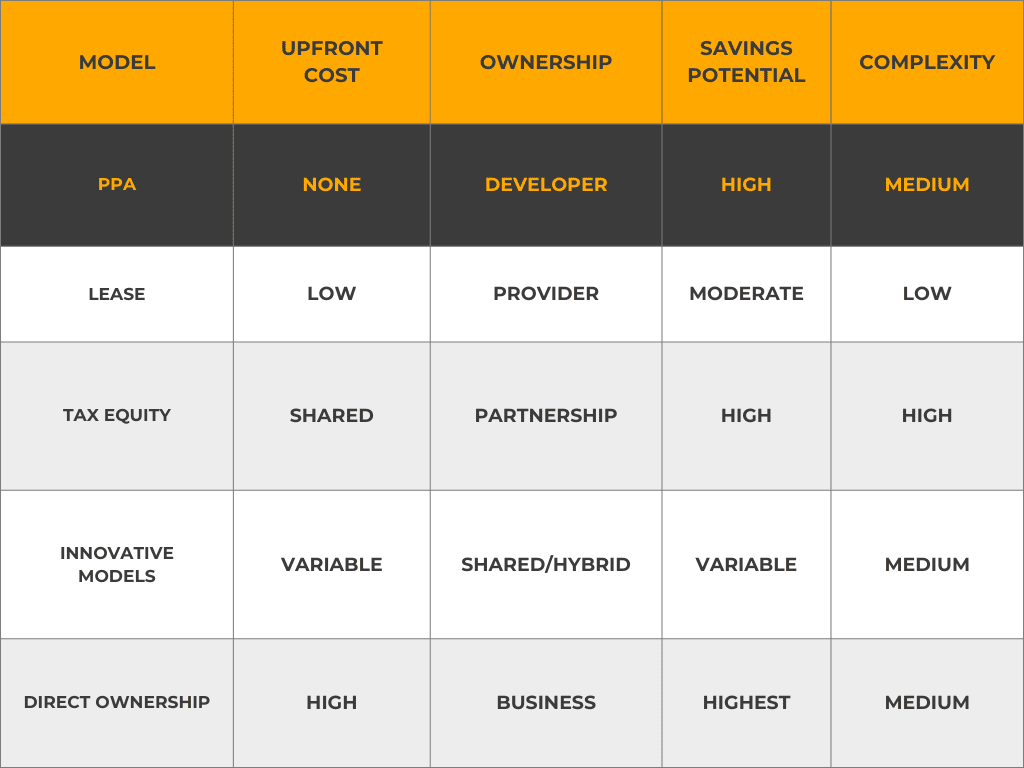
The best Financing Strategy for Commercial Solar depends on whether the priority is cash preservation, maximum ROI, or minimal complexity.
Regional Considerations
Location matters when structuring Financing Strategies for Commercial Solar. Utility rates, energy policies, and local market dynamics influence outcomes.
-
South Carolina: Strong opportunities for businesses; see our South Carolina Solar page.
-
Georgia: Competitive programs and financing support; visit Solar in Georgia.
-
Virginia: A growing market with expanding options; explore Virginia Solar Installation.
By tailoring financing to local conditions, companies can secure better terms and stronger returns.
Steps to Choose the Right Financing Strategy
-
Define goals – Focus on savings, ROI, or risk management.
-
Assess cash flow – Understand budget limitations.
-
Evaluate models – Compare PPAs, leases, tax equity, and direct ownership.
-
Review partners – Choose experienced providers with a proven track record.
-
Request detailed proposals – Look for clarity on terms, pricing, and obligations.
Taking these steps ensures a well-structured Financing Strategy for Commercial Solar that aligns with company objectives.
Common Mistakes Businesses Should Avoid
-
Chasing incentives alone – Incentives matter, but financing structure matters more.
-
Ignoring long-term contracts – Understand obligations before signing PPAs or leases.
-
Overestimating savings – Conservative projections prevent disappointment.
-
Skipping maintenance terms – Know who is responsible for upkeep.
Avoiding these pitfalls leads to smoother, more profitable projects.

The Future of Financing Strategies for Commercial Solar
The market continues to evolve. Expect to see:
-
Digital finance platforms simplifying access to investors.
-
Performance-based contracts linking payments to actual output.
-
Hybrid ownership structures blending multiple models.
These innovations will make Financing Strategies for Commercial Solar even more flexible and attractive in the years ahead.
Colite Technologies Can Help with Financing Strategies
Government incentives can spark interest, but long-term success requires creative, reliable Financing Strategies for Commercial Solar. Whether through power purchase agreements (PPA), solar leasing options, structured tax equity deals, or innovative solar finance models, businesses today have more tools than ever to make solar affordable and profitable.
By carefully evaluating goals, comparing financing methods, and considering regional factors in South Carolina, Georgia, and Virginia, companies can choose strategies that deliver predictable costs, strong ROI, and lasting energy independence.
Ready to explore your options? Visit our Commercial Solar Installation services, or check state-specific opportunities at South Carolina Solar, Solar in Georgia, and Virginia Solar Installation.
Commonly Asked Questions
Which Financing Strategy for Commercial Solar is best for small businesses?
Smaller companies often benefit from PPAs or leasing. Both minimize upfront costs while still delivering meaningful savings.
Do I lose control with a PPA?
Yes, the system is owned by the developer, but you gain predictable energy costs and avoid maintenance responsibilities.
Are innovative solar finance models safe for businesses?
Yes, when structured by reputable providers. These models—such as shared savings agreements—are designed to share benefits while limiting risk.
Is direct ownership always better long-term?
Direct ownership usually delivers the highest return, but it requires significant upfront capital. Businesses must weigh ROI against liquidity needs.
How do tax equity structures work?
They bring in outside investors who monetize credits and depreciation, reducing the project’s effective cost. This strategy suits larger businesses with access to strong investment partners.