
As 2026 approaches, one debate is heating up faster than the summer sun — Solar vs. Traditional Energy. With electricity rates climbing and grid instability becoming a growing concern, more businesses are asking the big question: Is it finally time to switch to solar?
The short answer — yes. Solar is no longer just an eco-conscious choice; it’s a strategic financial decision. Between massive long-term savings, energy independence, and predictable costs, solar power is quickly outpacing fossil-fueled electricity on every front.
In this guide, we’ll dive into a full energy cost comparison, exploring how Solar vs. Traditional energy sources in performance, price, and long-term value.
At Colite Technologies, we specialize in helping organizations transition to high-efficiency solar systems designed for maximum return. Let’s uncover why the balance is tipping firmly in solar’s favor for 2026 and beyond.
Understanding the Solar vs. Traditional Energy Divide
Before comparing savings, it’s important to understand what sets solar apart from conventional energy systems.
Traditional energy relies on non-renewable resources like coal, natural gas, and oil — all subject to global supply fluctuations, market speculation, and inflation.
Solar energy, on the other hand, is generated from an infinite resource: sunlight. Once the system is installed, operational costs are minimal, and the savings accumulate year after year.
The real shift is no longer about environmental benefits — it’s about financial survival.
Why 2026 Marks a Turning Point
The year 2026 is expected to be a landmark for businesses choosing between Solar vs. Traditional Energy. Several economic and policy factors are converging:
- Rising Utility Prices: Energy inflation continues across the U.S., particularly in the Southeast.
- Tax Incentives: The 30% federal investment credit (ITC) remains available for commercial installations.
- Technological Advances: Solar panels now achieve record efficiency rates, improving ROI dramatically.
- Corporate Sustainability Goals: More companies are committing to carbon-neutral operations by 2030.
These forces make solar adoption not just attractive, but almost inevitable for forward-thinking enterprises.
The True Energy Cost Comparison
To understand the financial argument, let’s run a basic energy cost comparison between the two models.
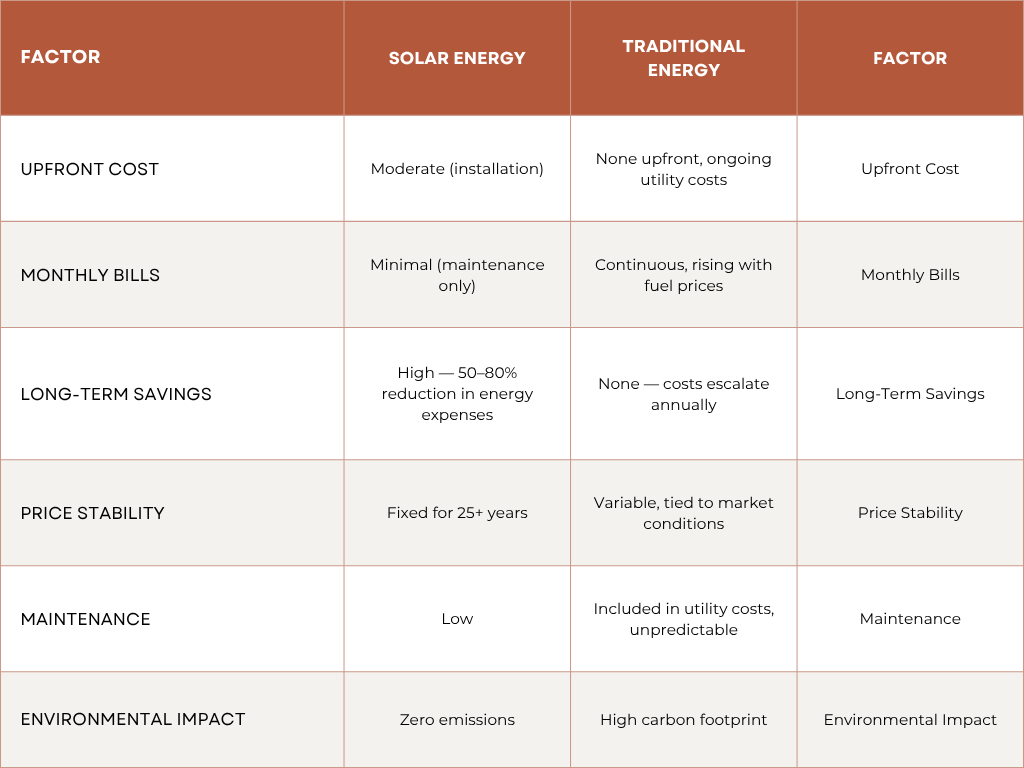
Over a 25-year lifespan, solar typically pays for itself within 5–7 years, after which your energy is virtually free — something traditional energy can never offer.
Solar Savings 2026: The Numbers That Matter
The projected solar savings 2026 data paints a clear picture of where the real value lies.
Example Scenario: Mid-Sized Business in South Carolina
- System Size: 250 kW
- Installation Cost: $350,000
- Tax Credit (30%): $105,000
- Net Cost: $245,000
- Annual Energy Savings: $50,000
- Payback Period: ~5 years
- 25-Year Lifetime Savings: Over $1 million
By comparison, sticking with grid-based power for the same facility could cost over $1.5 million during that same period due to rate inflation.
Visit our South Carolina Solar page to learn how similar projects are already delivering measurable business savings across the state.
Traditional Power Expenses: The Cost of Staying the Same
Choosing conventional electricity may seem convenient — but it’s a financial trap in disguise.
Traditional power expenses are tied to fossil fuel costs, utility infrastructure charges, and unpredictable market dynamics. Businesses have no control over future price hikes.
Why traditional energy costs more over time:
- Fuel volatility: Global energy markets drive unpredictable spikes.
- Transmission losses: Long-distance transport adds inefficiency.
- Utility overhead: Customers indirectly pay for grid upgrades.
- Demand charges: Commercial customers often face penalties for peak-hour usage.
Even a 3–5% annual increase compounds rapidly, meaning your business could end up paying 50–70% more within a decade — while solar costs remain fixed.
Clean Energy Benefits Beyond Savings
While financial benefits are clear, the clean energy benefits of solar go far beyond the balance sheet.

Key Advantages Include:
- Brand Reputation: Businesses adopting solar are seen as sustainability leaders.
- Employee Engagement: Teams take pride in working for environmentally responsible companies.
- Regulatory Readiness: States are introducing stricter emissions standards — solar helps you stay compliant.
- Energy Independence: Generate your own power and reduce reliance on the grid.
With many corporations integrating ESG (Environmental, Social, and Governance) goals, solar energy aligns perfectly with both sustainability and profitability.
Solar Efficiency Analysis: How Modern Panels Outperform Expectations
One of the strongest arguments in the Solar vs. Traditional Energy debate is how far solar efficiency has come.
A decade ago, commercial panels averaged 15–17% efficiency. Today, the best systems exceed 22–24%, converting more sunlight into usable power.
Solar vs. Traditional energy efficiency analysis shows that even in cloudy or cooler climates, today’s technology delivers impressive output.
Factors Driving Efficiency Gains:
- Bifacial panels capturing light from both sides.
- Advanced inverters improving conversion rates.
- Smarter racking designs reducing shading losses.
- AI-powered monitoring optimizing system performance.
With advanced performance tracking, companies can now measure exact output and savings in real time — something impossible with traditional energy bills.
Explore system options on our Commercial Solar Installation page to see how Colite’s tailored designs maximize efficiency for every business type.
Regional Comparison: Solar Growth in the Southeast
The Southeastern U.S. is rapidly becoming a hub for commercial solar investment.
- South Carolina: Leading the way with tax exemptions and energy credits.
- Georgia: Businesses benefit from low installation costs and flexible financing.
- Virginia: A growing market with strong net metering and corporate adoption.
Check out our regional insights at Solar in Georgia and Virginia Solar Installation to learn how state-specific incentives amplify the ROI of solar.
Breaking Down the Long-Term Value Equation
When comparing Solar vs. Traditional Energy, think of it like owning versus renting.
- Solar: You make an initial investment and then enjoy decades of free power.
- Traditional Energy: You keep paying indefinitely for a product you never own.
In financial terms, the ROI on commercial solar can reach 400–600% over 25 years. For traditional power, ROI is always 0% — it’s a continuous expense with no return.
How Businesses Can Maximize Solar Efficiency and ROI
Installing panels isn’t enough — performance and management play huge roles in achieving top-tier savings.
Tips to Maximize Returns:
- Right-Size Your System: Don’t overbuild. Tailor output to your usage profile.
- Integrate Storage: Batteries reduce peak demand costs.
- Monitor Regularly: Smart analytics ensure panels operate at full capacity.
- Schedule Preventive Maintenance: Keep inverters and connections clean and efficient.
- Work with Experts: Professional installers like Colite ensure design and financial optimization.
Each of these steps helps you extract the full value from your solar investment — ensuring your system consistently outperforms traditional alternatives.
Energy Security and Business Continuity
The reliability of traditional grids is weakening. Blackouts, weather events, and energy shortages are increasingly common.
Solar vs. Traditional energy systems with integrated battery storage provide critical protection against downtime. Businesses can maintain essential operations even when the grid fails — a key advantage in the Solar vs. Traditional Energy equation.
Energy independence not only boosts resilience but also safeguards profits by preventing costly interruptions.
Addressing Common Myths About Solar Costs
Despite proven solar savings 2026 projections, some misconceptions persist:
Myth 1: Solar is too expensive.
Reality: Installation costs have dropped by over 60% in the past decade, and financing options make solar accessible for any business size.
Myth 2: Solar doesn’t work on cloudy days.
Reality: Modern panels still generate energy under diffused light, maintaining high output even during overcast weather.
Myth 3: Traditional energy is more reliable.
Reality: Solar systems paired with batteries now outperform the grid in uptime and cost predictability.
The numbers prove it — solar isn’t a luxury anymore; it’s a competitive necessity.

Case Example: The Cost of Inaction
Let’s consider a logistics facility in Georgia consuming 500,000 kWh annually.
- Traditional Energy Cost (2026 average): $0.15/kWh
- Annual Expense: $75,000
- 25-Year Total: $1.87 million (assuming 3% inflation)
Switching to Solar:
- System Cost: $600,000
- Tax Credit (30%): $180,000
- Net Cost: $420,000
- Payback: ~6 years
- Lifetime Savings: Over $1.2 million
The facility locks in a fixed, low energy rate while adding tangible asset value to its property.
That’s the power of making the right choice in the Solar vs. Traditional Energy debate.
The Environmental Edge: Clean Energy as a Competitive Advantage
Sustainability has evolved from corporate buzzword to strategic advantage. Customers, investors, and partners increasingly demand measurable environmental responsibility.
By switching to solar, your business can reduce CO₂ emissions dramatically while appealing to eco-conscious clients.
In many industries — from manufacturing to retail — being able to demonstrate clean energy benefits directly influences purchasing decisions and brand loyalty.
The Future Outlook: Solar Dominance by 2030
Industry experts predict that within the next five years, Solar vs. Traditional Energy will no longer even be a comparison — solar will lead in affordability, adoption, and innovation.
- Energy storage costs will continue to fall.
- Smart grids will integrate solar into mainstream infrastructure.
- Corporate adoption will reach record levels as ROI strengthens.
Businesses that act now will benefit from first-mover advantages — from lower costs to enhanced market reputation.
Final Thoughts: The Smarter Energy Choice for 2026
The data doesn’t lie. In the Solar vs. Traditional Energy debate, solar wins decisively — on cost, stability, efficiency, and sustainability. With incentives at their peak and technology advancing rapidly, 2026 represents the ideal window for businesses to switch to solar and start reaping substantial financial and operational benefits.
Ready to make the smarter energy choice for your business? Visit Colite Technologies today to explore your custom solar strategy and discover how much you can save in 2026 and beyond.