

Big news in clean energy policy: On July 9, 2025, former President Trump signed the One Big Beautiful Bill (OBBB) into law—marking a pivotal shift in how U.S. solar tax incentives work for both homeowners and businesses. While the 30% Investment Tax Credit (ITC) is still alive, there are critical deadlines and updated rules you need to know.
If you’re a business owner aiming to cut utility bills or looking to future-proof your energy costs, understanding these changes now can save you thousands on solar tax credit.
Let’s break it down—clearly, quickly, and with real-world relevance.
A Refresher: What Are Solar Incentives?
Before we unpack what’s changed, here’s a quick recap:
Investment Tax Credit (ITC)
The cornerstone of federal solar incentives, the ITC lets you deduct 30% of your total solar installation cost—from panels to batteries—directly from your federal income taxes. This applies to both residential and commercial systems.
Production Tax Credit (PTC)
Best suited for large-scale commercial solar, the PTC rewards system owners per kilowatt-hour (kWh) produced, typically over 10 years.
Inflation Reduction Act (IRA) Legacy
The IRA of 2022 boosted solar incentives and introduced bonuses for:
-
Domestic content use
-
Prevailing wage and apprenticeship standards
-
Energy communities (previously fossil-fuel-reliant zones)
The OBBB now modifies—but does not eliminate many of these benefits.
What Just Happened: The One Big Beautiful Bill (OBBB)
Signed into law in July 2025, OBBB introduces new eligibility deadlines, modified bonus credits, and stricter domestic sourcing requirements. While it preserves the 30% ITC, it adds urgency and new complexity.
What’s Still Available?
-
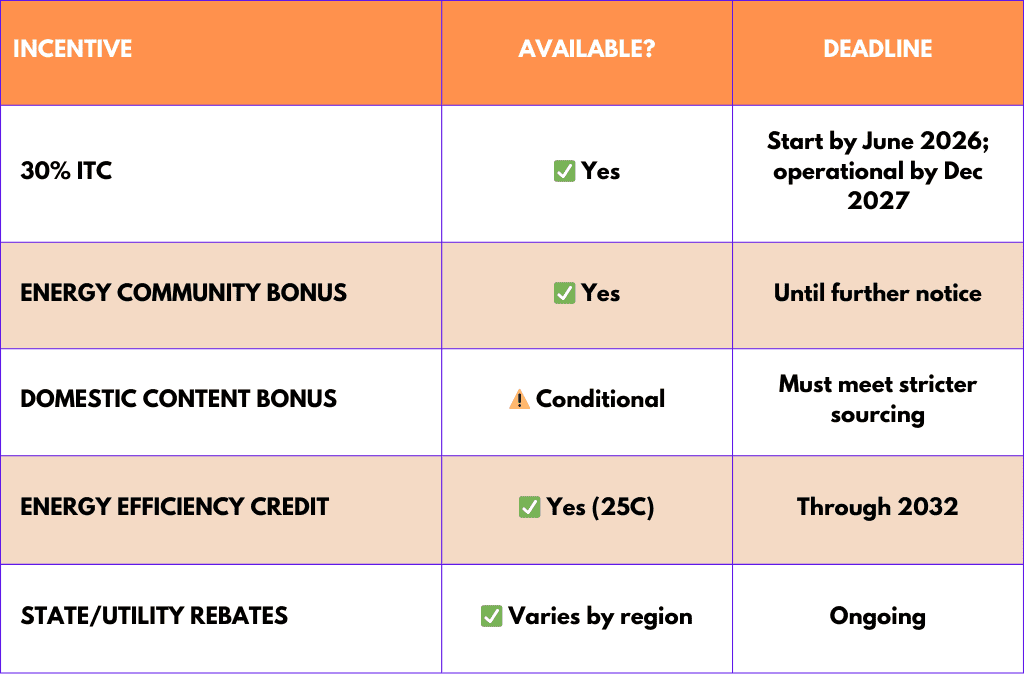
30% ITC remains available if:
-
Your solar project starts construction before June 30, 2026
-
Or is placed in service before December 31, 2027
-
This applies to both residential and commercial projects.
What’s Changing in 2025?
1. Stricter Domestic Content Requirements
To qualify for additional ITC bonuses (up to 10%), systems must use a minimum percentage of U.S.-made components.
2. FEOC Limitations
For projects that start in 2026 or later, there is a new rule that can limit an owner’s ability to claim the base 30% ITC. It is related to the cost ratio of the total project that can be attributed to a “prohibited foreign entity” (i.e. China). Colite Technologies will leverage its relationships with multiple vendors and suppliers to define a sourcing strategy that will enable our projects to meet the new standards.
3. Energy Community Bonus Still Applies
The 10% bonus for projects located in or benefiting energy communities (such as former coal towns) remains intact under OBBB—great news for developers in those regions.
What This Means for Businesses
For Commercial Solar Projects:
-
-
Start planning now to “safe harbor” your project in 2025
-
Lock in components, secure permits, and document construction milestones
-
Domestic sourcing matters more than ever to retain full incentives
-
OBBB means the feared ITC rollback didn’t happen—but only if you act before the new deadlines
-
Solar Tax Credits
What You Can Still Stack in 2025
Energy Efficiency Solar Tax Credits (25C)
Pair solar with upgrades like:
-
Heat pumps
-
Insulation
-
EV chargers
-
Windows and doors
You could claim up to $3,200 annually through 2032.
State & Utility Rebates
Many states and utilities continue to offer:
-
Property tax exemptions
-
Upfront cash rebates
-
Net metering
-
Performance-based incentives
These can combine with the federal ITC for deeper savings.
Action Plan: How to Lock in Your Benefits
1. Don’t Wait
Start your solar journey now. By Q4 2025, installer schedules and supply chains will be packed.
-
Book site assessments
-
Finalize engineering and permitting
-
Choose verified U.S.-made components
-
Keep all documentation to support ITC eligibility
2. Leverage Solar + Storage
-
Solar + battery systems still qualify for the 30% ITC
-
Get added resilience + potential for virtual power plant (VPP) participation
3. Install EV Chargers
Get up to $1,000 in federal credit, plus utility rebates—especially for rural and low-income locations.
4. Monitor Component Sourcing
If your project uses panels or racking from restricted countries, your entire ITC or bonus eligibility may be revoked.
2025 Solar Tax Incentive Cheat Sheet
What to Watch Next
-
Senate Regulations: Monitor for any additional clarifications or phase-in timelines
-
Supply Chain Volatility: More domestic demand = higher prices. Act early.
-
State Tax Incentives: Stay informed about regional changes for maximum ROI
Final Thoughts: Seize the Solar Moment
2025 is no longer just a planning year—it’s a countdown.
With the OBBB in effect, the 30% ITC survives, but only if you move before the deadlines. Don’t gamble on future extensions. Secure your system and your savings now.
Colite Technologies: Your Strategic Solar Partner
At Colite Technologies, we guide homeowners and businesses through every step of the process:
-
Maximize available Solar Tax Credits
-
Navigate compliance under the new OBBB rules
-
Design energy-efficient solar + battery systems
-
Leverage all local, state, and federal incentives
Let’s lock in your savings before time runs out.
Contact us today to learn more about Solar Tax and schedule your free consultation.